
Currency Exchange and Your Dubai Real Estate Investment
: The Complete Forex Guide (2026)
By Luxbury Team · Finance · April 2026
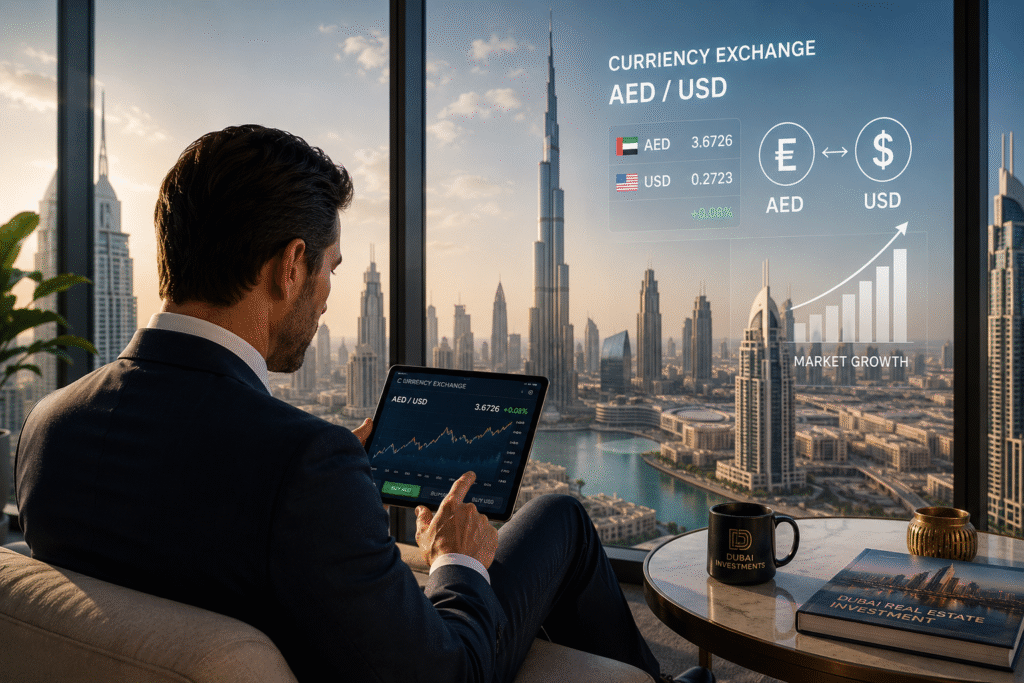
Dubai’s property market is priced in UAE Dirhams. The buyers, however, are overwhelmingly international — from the UK, Germany, India, Russia, China, and beyond. When your home currency shifts against the AED before, during, or after a transaction, the real-world cost of your investment changes even if the listed price stays exactly the same.
Currency exchange and Dubai real estate play a critical role in determining the true cost and profitability of international property investments in the UAE. While Dubai properties are priced in AED, most investors evaluate their returns in their home currency, which means even small fluctuations in USD-linked exchange rates can significantly impact overall investment performance. Understanding how Dubai real estate currency exchange dynamics work is essential for accurately assessing entry prices, rental yields, and long-term capital gains.
This is not a marginal concern. For a European investor purchasing an AED 2,000,000 apartment at current rates, a 5% depreciation in the Euro against the USD — the reference currency for the AED peg — adds over €25,000 to the effective purchase price before a single dirham changes hands.
Understanding currency exchange and forex fluctuations is essential to accurately evaluate returns and manage risks in Dubai real estate investments. Yet it remains one of the most consistently overlooked elements of the investment calculation.
This guide provides a research-backed view of how currency risk works in Dubai property, how it affects every stage of the investment lifecycle, and the practical strategies investors use to protect and maximise their returns.
Why Currency Risk Is Inseparable from Dubai Property Investment
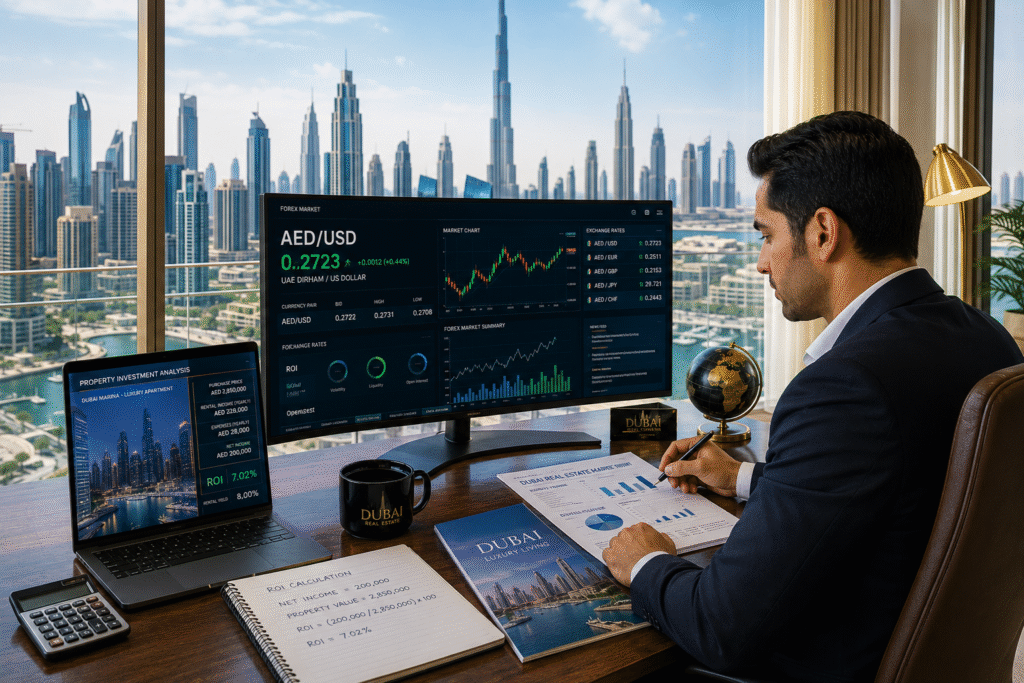
The UAE dirham has been pegged to the US dollar at a fixed rate of 3.6725 since 1997 and has never been devalued. This peg is one of Dubai real estate’s most underappreciated structural advantages—but it also determines exactly where currency risk sits for international investors.
Because the AED tracks the USD, your actual forex exposure as a non-US investor is not against the Dirham itself. It is against the US dollar. The currency pairs that matter are GBP/USD, EUR/USD, INR/USD, and the equivalent for your home currency. When the dollar strengthens globally, the AED strengthens with it — and Dubai properties become more expensive in your local currency even if no AED price has changed.
For USD-based investors, the peg is effectively a zero-currency-risk environment. Purchase price, rental income, and exit proceeds all convert to USD at a known, stable rate. For investors from other currency zones, the peg at least simplifies the hedging equation: you only need to manage one pair rather than tracking a volatile emerging-market currency with policy risk.
The AED peg is backed by the sovereign wealth of the UAE. The Abu Dhabi Investment Authority alone manages an estimated one trillion dollars in assets, providing substantial credibility to the peg’s permanence. This is not a managed exchange rate held together by short-term policy—it is one of the most structurally sound currency pegs in the world.
The Three Ways Forex Fluctuations Hit Your ROI
Currency exposure in Dubai real estate is not a one-time event at the point of purchase. It affects the investment across its full lifecycle through three distinct channels.
Purchase cost fluctuations occur when a weaker home currency increases the effective AED cost of buying. Between 2020 and 2023, the Indian rupee depreciated significantly against the USD, making Dubai properties materially more expensive for Indian investors in rupee terms—even as AED prices held flat. European investors faced the same pressure during EUR/USD volatility in the same period. The AED price did not change. The effective cost in the buyer’s home currency did.
Rental income volatility emerges when investors repatriate AED-denominated rental income back to their home currency. A gross rental yield of 7% in AED may translate to an effective 5.5% in GBP if sterling has appreciated 20% against the dollar since the purchase date. The property is performing exactly as expected in the Dubai market. The investor’s home-currency return is telling a different story.
Capital gains impact at exit is the channel most investors discover too late. When a property is sold, AED proceeds must be converted back to the investor’s home currency. A
Home currency that has strengthened significantly since the original purchase will reduce the nominal gain in local terms—a hidden cost built up silently across the holding period.
A Worked Example: The Real Cost of Currency Movement
To make this concrete, consider a British buyer purchasing an AED 1,800,000 apartment.
At the time of viewing, GBP/AED stands at 4.62 — making the effective purchase cost £389,610. By the time funds are transferred, sterling has weakened to 4.30 against the dollar. The same AED 1,800,000 property now costs £418,605. The buyer has paid an additional £28,995 without any change in the AED price, no renegotiation, and no additional fees. The cost increase is purely the product of currency movement across a few weeks.
Had sterling strengthened to 4.90 over the same period, that same buyer would have paid just £367,347 — saving over £22,000 on an identical transaction.
This range — a swing of more than £51,000 on a single mid-market purchase — illustrates why locking in an exchange rate before completion is not optional for serious investors. It is standard risk management.
2026 Dubai Market Context: Why Currency Strategy Matters More Than Ever
Dubai’s real estate market opened in 2026 at a record pace. Q1 2026 alone recorded AED 176.7 billion in total sales across nearly 48,000 transactions — a 23.4% increase in value year-on-year. January 2026 registered AED 72.4 billion in a single month, the highest monthly figure in the history of Dubai real estate. The average price per square foot rose 12.5% year-on-year to AED 1,759, with value growth significantly outpacing volume growth — the defining signal of a market driven by price strength rather than speculative volume.
The IMF projects UAE GDP growth at 5.0% for 2026, the fastest in the GCC, supported by a population that surpassed 4 million in 2025 and is expected to add up to 225,000 new residents this year alone. Off-plan properties accounted for 70% of total Q1 2026 transaction volume, reflecting deep developer pipelines and sustained buyer confidence.
Rental yields remain highly competitive by global standards. Average gross yields sit between 6% and 9% across Dubai, with mid-market communities such as Jumeirah Village Circle achieving up to 8.5%. The broader picture shows apartments averaging approximately 7% gross, roughly double what investors earn in mature cities such as London or New York. Price appreciation in 2026 is forecast to moderate to mid-single-digit levels of 5–8% as the market transitions into a more balanced phase following several years of exceptional growth—a natural maturation rather than a correction.
For currency-exposed international investors, the supply context matters. Approximately 120,000 new residential units are scheduled for delivery in Dubai during 2026. In communities where new handovers exceed immediate tenant absorption — particularly JVC and Business Bay — some near-term rental yield compression is possible. Investors should factor this into their currency-adjusted return models, particularly if income repatriation is a core part of the investment thesis.
Dubai Rental Yields by Area (2026)
For investors calculating currency-adjusted returns, the starting gross yield is the foundation of the model. The following figures reflect current 2026 market data.
JVC and Al Furjan
deliver gross yields of 7% to 8.5% on apartments, with higher FX sensitivity given the mid-market, price-sensitive tenant base. JVC led both completed supply and ready apartment transaction volumes in Q1 2026, confirming its continued dominance as Dubai’s highest-volume rental market.
Dubai Marina
delivers 6% to 9% gross, with a moderate FX sensitivity profile reflecting its international expat tenant population.
Downtown Dubai
sits at 5% to 7% gross, with lower FX sensitivity due to premium, dollarized demand from high-net-worth tenants.
Palm Jumeirah
delivers 4% to 6% on villas and apartments, with the lowest FX sensitivity in the market given its ultra-high-net-worth buyer and tenant profile. Emirates Hills and Palm Jumeirah are delivering the highest per-square-foot values and strongest quarterly price appreciation in Q1 2026.
Business Bay
offers 6% to 8% gross on apartments, with moderate FX sensitivity and strong corporate tenant demand—though near-term yield compression is possible as new supply enters this corridor through 2026.
The pattern is clear: higher-yield, mid-market areas carry more FX sensitivity, because tenant demand in those communities is more likely to come from currency-exposed expatriates. Premium locations, where demand is driven by dollar-denominated wealth, offer more natural hedging against home-currency swings.
5 Strategies to Manage Currency Risk in Dubai Property Deals
Strategy 1 — Use a Forward Contract to Lock Your Rate
A forward contract allows you to lock in today’s exchange rate for a future transaction date, typically up to 12 months ahead. For off-plan buyers with a handover date six to twelve months away, this eliminates the risk of home currency depreciation between signing and transfer. The contract is arranged through a licensed forex broker or specialist FX provider, not a high-street bank. Forward contracts are particularly valuable in volatile rate environments and cost nothing to set up with most specialist providers.
Strategy 2 — Use a Specialist FX Provider, Not Your Bank
Banks typically add a 2% to 4% margin on large forex transfers. On an AED 2,000,000 purchase funded from abroad, using a specialist provider rather than a bank wire can save between AED 20,000 and AED 60,000 in conversion costs alone—enough to cover the full Dubai Land Department transfer fee. Licensed providers operating in the UAE include Al Ansari Exchange and Al Ahalia Money Exchange Bureau. International specialist platforms such as OFX and Currencies Direct offer competitive spreads on major pairs with same-day or next-day settlement.
Strategy 3 — Consider UAE Local Financing
Rather than transferring a large lump sum from abroad, explore UAE mortgage financing. UAE banks offer mortgages to non-resident foreign investors with a 20% down payment on properties below AED 5 million. In Q1 2026, 67% of resale market transactions were mortgage-funded, reflecting a broader shift toward long-term ownership structures. Financing locally in AED limits your currency conversion exposure to the deposit amount only, while the larger debt component sits natively in the same currency as your rental income—creating a natural internal hedge across the life of the loan.
Strategy 4 — Monitor USD, Not AED
Because the AED is pegged, tracking AED exchange rates directly provides little useful information. The signal to watch is your home currency’s movement against the US dollar. When your home currency is strong relative to its historical USD range, that is the optimal window to convert. A forex advisor can set automated rate alerts on your behalf, removing the need for daily monitoring and ensuring you act when conditions are genuinely favorable rather than simply convenient.
Strategy 5 — Stress-Test Your ROI Across Three Scenarios
Run your investment return calculations under a base case with rates broadly flat, a bear case with your home currency weakening 10% to 15%, and a bull case with your home currency strengthening 10% to 15%. This stress testing reveals which investments are genuinely robust and which only appear attractive under a single favorable FX assumption. Given that 2026 brings a significant supply pipeline and moderating price growth forecasts, this discipline is more important than ever. Investments that still deliver acceptable returns under the bear case are defensible. Those that do not should be approached with caution, regardless of how the gross AED yield looks on paper.
Repatriating Profits: What Dubai Investors Need to Know
One of Dubai’s major structural advantages for international investors is the complete absence of foreign exchange controls. The UAE imposes no restrictions on capital repatriation. Rental income, sale proceeds, or any other funds can be transferred internationally at any time, in any amount—a freedom that is genuinely uncommon in global markets and compares favorably with the restrictions investors face in India, China, and many other property markets.
For transfers above AED 55,000, UAE exchange houses and banks require a valid passport or Emirates ID, proof of source of funds in the form of salary certificates, bank statements, or property sale contracts, and the beneficiary’s full banking details. For property-related transfers, a copy of the signed Sale and Purchase Agreement is typically required.
Consolidating outbound transfers through a single licensed provider is advisable where possible. Multiple small transfers trigger more anti-money laundering queries than a single well-documented large transfer and can introduce delays to what should be a straightforward process.
How to Calculate Your True Currency-Adjusted Return
Published yield figures in Dubai are stated in AED terms. The figure that matters for international investors is the currency-adjusted net yield — what actually arrives in their home currency after conversion costs and exchange rate movement across the holding period.
The calculation has five steps. First, calculate the gross AED yield by dividing the annual rent by the property price. Second, deduct running costs, including service charges, maintenance, and a 5% vacancy allowance. Third, convert the net AED income to your home currency using your current or locked exchange rate. Fourth, deduct the FX conversion margin — a well-negotiated specialist rate should be below 0.5%. Fifth, apply your sensitivity scenarios: what does the yield look like if your home currency moves 10% to 15% in either direction across your holding period?
As a concrete illustration, a Dubai apartment delivering a 7% net AED yield might deliver anywhere from 5.7% to 8.2% in GBP terms, depending on sterling’s movement against the USD across a five-year hold. With 2026 projecting moderating rental growth of 5–8%, investors who do not model currency sensitivity alongside market fundamentals are working with an incomplete picture of their actual expected return.
Meraas: Lifestyle and Urban Living
Best for: Lifestyle-driven buyers, urban professionals, City Walk, and Bluewaters
Meraas has long carved a niche in urban living that blends creativity with convenience. Key projects include City Walk — a vibrant, mixed-use street-level community — and Bluewaters Island, home to retail, leisure, and luxury residences. The Dubai Holding integration brings both Nakheel’s scale and Meraas’s design focus into a powerful combined portfolio.
Meraas developments are characterized by their integration of residential living with retail, hospitality, and cultural destinations. By average sale price per unit, Meraas was the clear leader in Q1 2026 at AED 7.37 million per transaction, reflecting the premium positioning of its product and the strength of demand from high-net-worth buyers seeking lifestyle-led communities.
Frequently Asked Questions
Is the AED a stable currency for real estate investment? Yes. The AED has been pegged to the USD at 3.6725 since 1997 and has never been devalued. The peg is backed by the UAE’s substantial sovereign wealth reserves. For dollar-based investors, there is effectively zero currency risk. For non-dollar investors, exposure exists only against the USD, which simplifies hedging considerably.
Can I freely repatriate rental income and sale proceeds from Dubai? Yes. The UAE imposes no foreign exchange controls. Funds can be transferred internationally at any time and in any amount, provided standard anti-money laundering documentation requirements are met for transfers above AED 55,000.
What is the best way to transfer money to buy a property in Dubai? Use a specialist FX provider rather than your bank. Banks add a 2% to 4% margin on large transfers—on an AED 2 million purchase, this represents AED 20,000 to AED 60,000 in unnecessary cost. Arrange a forward contract to lock today’s rate if your completion is weeks or months away.
Do Dubai rental yield figures account for currency risk? No. Published yields of 6% to 9% gross are stated in AED terms. International investors must calculate a currency-adjusted yield by applying their home currency’s movement against the USD across the holding period and deducting FX conversion costs on each income repatriation.
What does the 2026 supply pipeline mean for rental yields? Approximately 120,000 new residential units are scheduled for delivery in Dubai during 2026. In high-supply communities, some near-term yield compression is possible. Investors should target areas where population inflows and employment growth are sustaining tenant demand — JVC, Dubai Marina, and Business Bay remain the most liquid rental markets despite incoming supply.
Final Thought
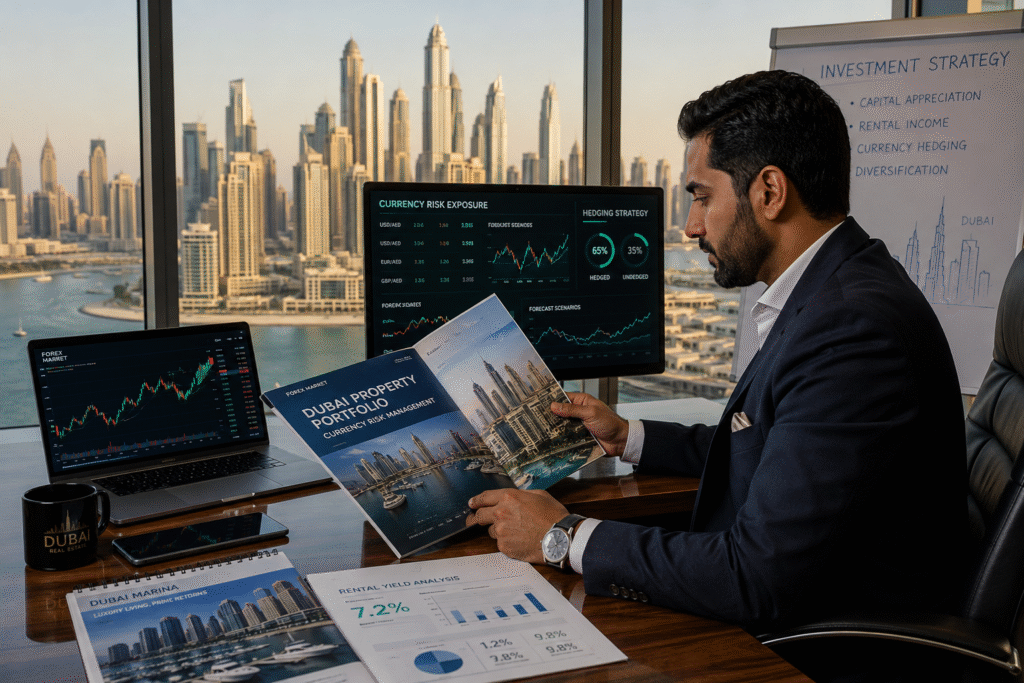
Dubai real estate offers some of the most compelling fundamentals of any global property market entering 2026—rental yields of 6% to 9%, zero income or capital gains tax, a stable USD-pegged currency, and a regulatory framework that actively protects investor capital. Q1 2026 data confirms the market is maturing rather than cooling, with value growth significantly outpacing volume and institutional confidence building across commercial and residential segments alike.
Ultimately, successful investors in Currency Exchange Dubai real estate treat forex exposure as part of their core investment planning rather than an afterthought. By accounting for exchange rate volatility at the purchase, holding, and exit stages, investors can better protect their ROI and avoid unexpected erosion of profits. In a market as active and globally driven as Dubai, managing currency exposure is just as important as selecting the right location or property type.
But for international buyers, the currency layer can make or break the returns that are actually received. The investors who perform best are those who plan their currency exposure from day one. They use specialist FX providers to reduce conversion costs. They lock in exchange rates with forward contracts before completion. They stress-test their ROI across currency scenarios rather than assuming a single rate. And they understand that their real risk is against the US dollar—not some volatile or unpredictable local currency.
With the right forex framework in place, currency risk in Dubai properties becomes manageable rather than threatening. The market’s underlying fundamentals—population
growth, income tax exemption, infrastructure investment, and a globally mobile tenant base — remain firmly intact. Investors who understand and plan for currency exposure are simply better positioned to capture those fundamentals in full.
Want to understand how currency considerations apply to a specific Dubai property or investment strategy? Get in touch with the Luxbury Team for a personalised consultation.